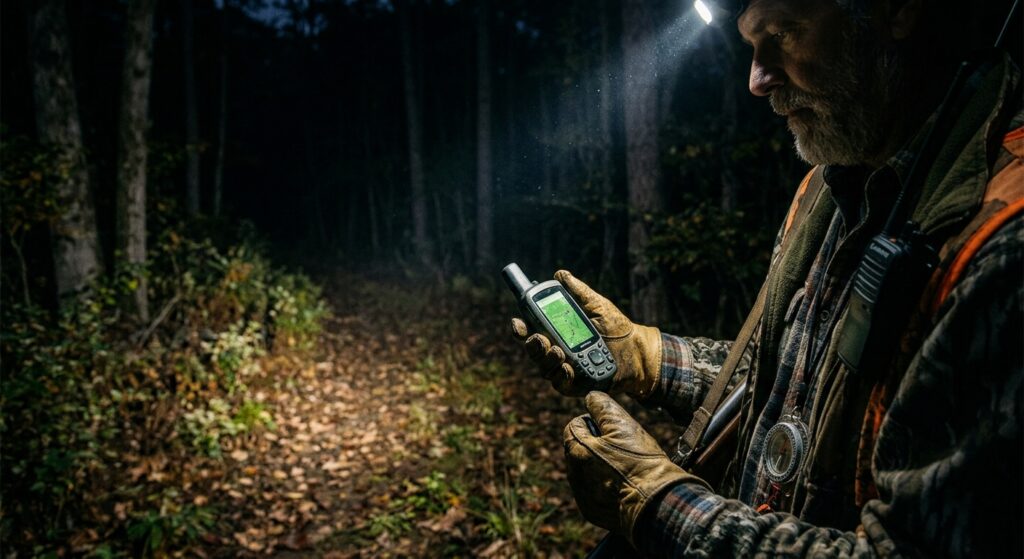
It’s full dark, ten minutes into the drop, and your coonhound is working a track hard. Then the mouth changes. Faster, more excited, the kind of open that doesn’t sound like a coon. You know that sound. Deer, probably. Your thumb finds the button before you’ve even decided to press it.
That reflex, thumb on the button before the brain catches up, is where most e-collar problems start. Not with the collar itself. With what happens in the half second before the stimulation goes out.
Handlers blame the collar for a lot of things it never actually did. A dog that won’t stay treed. One that keeps running trash no matter how many times it’s been popped. One that goes quiet and hangs back the second the transmitter comes out of the pocket. All three of those get blamed on the tool. Almost none of them are the tool’s fault.
The collar is not a training program. It’s a correction delivery system, and it only works on behavior the dog already understands. When a handler reaches for it to fix something the dog was never actually taught, the collar doesn’t create the fix. It creates confusion that looks like a training problem for months afterward. Good coonhound training was never really about the equipment. It’s about what the dog understood before the equipment ever entered the picture.
What the Collar Is Actually Correcting
An e-collar does one thing well. It marks a moment. It tells a dog, at the exact instant of a specific behavior, that the behavior was wrong. That’s it. It has no ability to teach a dog what the right behavior looks like, and no ability to explain why the wrong one was wrong. Those two things have to already exist in the dog’s head before the correction means anything.
Most of the trouble handlers run into with e-collars traces back to skipping that step. The dog gets the collar before it has ever been taught, in a low-distraction setting, what leave it or come here or quit that actually means. So the first time the stim goes out, the dog isn’t connecting it to a known cue it failed to obey. It’s just getting hit with something unpleasant during whatever it happened to be doing at the time.
That’s not correction. That’s noise. And a dog that’s been hit with enough noise learns one of two things. Either it gets careful and hesitant about everything, second-guessing normal hunting behavior along with the bad habit you were actually trying to stop. Or it learns the correction is unpredictable and starts tuning it out entirely, which is usually when a handler decides the dog is collar wise and turns the stim level up. Neither one is the dog’s fault. Both are the direct result of pressure applied to a foundation that was never built.
This is the same pattern that shows up in a young dog that was never required to carry a hunt on its own before it got run with a full pack. The article on why a young coonhound checks back after too much company covers a version of this exact problem from a different angle: a dog leaning on something outside itself, whether that’s other dogs or a correction it doesn’t understand, instead of a foundation it actually owns. The collar can end up playing the same role the pack does. The dog checks in with the correction instead of thinking a problem through on its own.
If your dog runs trash and you’ve been correcting it every time with the transmitter, but the running hasn’t slowed down after a full season of that, the issue almost certainly isn’t stim level. It’s that the dog was never taught what trash means to you in a setting where it could actually learn the lesson. The collar has been delivering a consequence attached to nothing.
Teaching the Behavior Before You Ever Press the Button
The fix isn’t a different collar setting. It’s building the behavior on the ground first, with the transmitter either off or used only to reinforce something the dog already knows how to do.
Start with obedience work that has nothing to do with hunting. Recall, a solid leave it, a command that stops forward motion cold. Teach these on a lead, in a yard or open field with no game scent around, using the collar at the lowest level the dog can feel, paired every single time with the verbal command and a release into praise. The dog needs dozens of repetitions where it learns the sequence: command, then stim if it doesn’t comply, then relief and praise the instant it does. That sequence is the entire lesson. Skip the low-distraction repetitions and jump straight to correcting a live trash chase, and the dog never gets the chance to learn the sequence at all.
Once the obedience piece is solid on the ground, you can start layering it into real hunting situations, but the transmitter’s job stays the same. It reinforces a command the dog already knows. If your dog has never been taught a reliable recall away from a deer track in a controlled setting, popping it mid-chase on a live hunt isn’t reinforcing anything. It’s just delivering pressure with no instruction attached to it.
Timing matters as much as the groundwork does. A correction needs to land within roughly a second or two of the behavior you’re trying to stop, or the dog has no real way to connect the two. Coon hunters have known this for generations without needing a textbook to tell them. A dog corrected on a deer track thirty seconds after it opened isn’t learning not to run deer. It’s learning that sometimes, for no reason it can identify, unpleasant things happen while it’s out hunting. That’s how you build a hesitant dog instead of a broke one.
The same principle holds for treeing problems. A dog that slicks a tree or won’t stay treed sometimes gets corrected well after the fact, once the handler finally catches up in the dark and realizes what happened. By then the moment is gone. The correction lands on whatever the dog is doing when the handler arrives, which is usually standing there confused, not the actual mistake made minutes earlier.
Where Handlers Get the Timing Wrong
The most common mistake isn’t stim level. It’s reaching for the collar the moment things go sideways, before there’s been any real foundation laid down to correct against. A handler watches a young dog blow through a track, feels the frustration climb, and starts correcting on instinct instead of on a plan. That’s pressure without a target, and dogs read the difference between a correction tied to a clear expectation and one tied to a handler’s mood.
That same instinct shows up under a different kind of pressure too. The first time a coonhound draws out in a nite hunt cast often exposes handlers who normally hunt quiet and patient at home but tighten up the moment points are on the board. The transmitter comes out faster and gets used more, and the dog feels that shift even if it can’t name it. Handler behavior under pressure can turn the collar from a tool into a symptom of the handler’s own nerves.
Overcorrecting is the second big mistake, and it usually comes from a handler trying to fix in one hunt what took months to build wrong in the first place. A dog that’s confused about what earns a correction doesn’t get less confused because the stim level went up. It gets more careful about everything, which can look like obedience for a week or two and then shows up later as a dog that hangs back at the drop or won’t commit at the tree, because it’s learned that acting confidently sometimes gets punished for reasons it never figured out.
Worth saying plainly, because it doesn’t get said enough. Sometimes the problem isn’t timing or foundation at all. Some dogs are simply wired to run more trash than others, or slower to develop the kind of impulse control a hot nosed dog needs around deer sign. No amount of correct e-collar mechanics turns a dog with weak natural discipline into one with strong natural discipline. Good timing gets you the most out of what the dog actually has. It doesn’t manufacture ability that isn’t there to begin with.
A 2020 study out of the University of Porto that compared training methods across dog schools found that welfare problems tracked more closely with how often aversive corrections were used than with which specific tool delivered them . That lines up with what most experienced handlers already know by feel. A collar used sparingly and only against a known cue causes far fewer problems than one used constantly regardless of its stim level.
Do This / Don’t Do This
Do this:
- Teach every command the collar will reinforce in a low-distraction setting first
- Pair the stim with the command every single time, followed by release and praise
- Correct within a second or two of the behavior, not after the fact
- Keep your own behavior on a cast or hard hunt the same as it is in routine training
- Use the lowest stim level that produces a response, and only raise it after confirming the dog understands the cue
Don’t do this:
- Reach for the transmitter to fix a behavior the dog was never taught on the ground
- Correct a dog that’s confused rather than defiant
- Raise the stim level because a lower one isn’t working without checking whether the foundation is missing
- Get tighter and more trigger happy with the collar the moment a hunt gets stressful
- Assume every trash running or slick treeing problem is a collar problem instead of a foundation problem
When the Collar Isn’t the Answer
There are situations where reaching for the transmitter makes a real problem worse instead of better. A young dog still building confidence on new ground doesn’t need pressure added to uncertainty it’s already working through. If it’s hesitant, exploring cautiously, or still learning what the woods feel like at night, a correction aimed at slowing it down even more usually backfires into a dog that stops trying things at all.
The same goes for a dog already showing signs of being collar shy or overcorrected. Hanging back at the truck. Refusing to range out. Watching the handler instead of hunting. Adding more stim to that picture doesn’t rebuild confidence. It digs the hole deeper. That dog needs time off the collar entirely, rebuilding drive and trust through hunts where nothing negative happens, before any correction gets reintroduced at all.
And if you genuinely don’t know whether your dog understands the command you’re about to correct against, that’s the moment to stop and go back to the ground work instead of pressing the button and hoping for the best. A correction against an unclear expectation isn’t training. It’s just pressure, and pressure without a clear target rarely builds the dog you’re after.
Before You Load Up Tonight
- Confirm the dog reliably knows the command you plan to correct against, away from any hunting situation
- Check that your correction timing is landing within a second or two of the behavior, not after
- Watch your own tension level on the next hard hunt and keep it matched to your normal quiet handling
- If the dog seems confused rather than defiant, back off the collar and rebuild the command on the ground
- Use the lowest stim level that gets a response before assuming you need to go higher
A coonhound that runs trash or won’t stay treed isn’t usually telling you it needs a harder correction. It’s telling you where the foundation is thin. The collar can sharpen a lesson the dog already understands. It can’t teach that lesson from scratch, and it can’t make up for training that never happened.
Handlers who get the most out of an e-collar aren’t the ones with the most aggressive settings. They’re the ones who did the boring work first, teaching the command clean, on the ground, before pressure ever entered the picture. That work doesn’t show up the night you flip the transmitter on. It shows up every night after, when the correction actually means something to the dog on the other end of it.
Get the foundation right and the collar becomes what it was always meant to be, a way to sharpen a lesson your dog already knows. Skip it, and no setting on the transmitter will get you there.