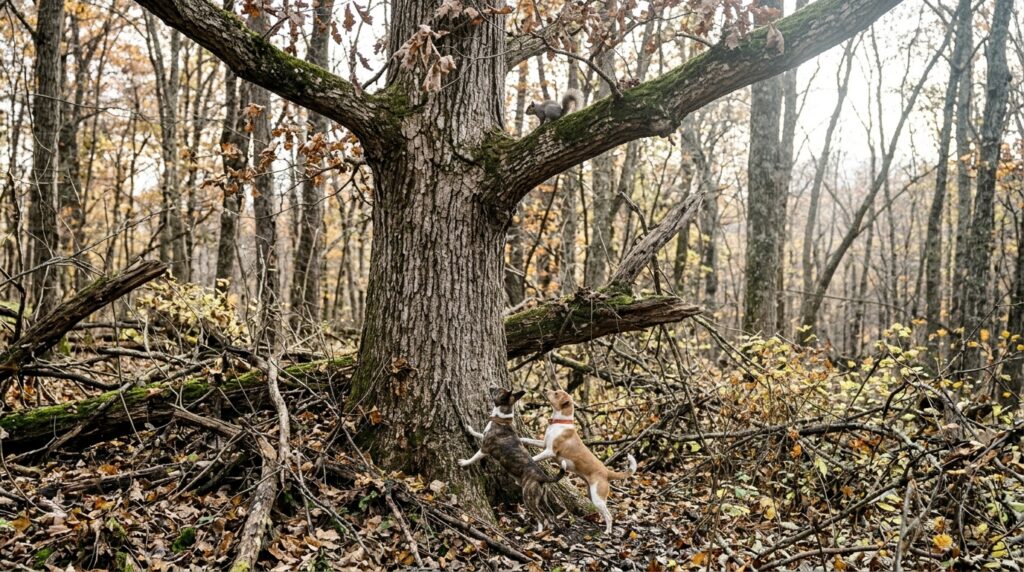
You have two listings open on your phone. One says Treeing Feist pups, UKC papered, parents tree every day. The other says Mountain Feist pups, same price, same promise. You flip the pictures back and forth and you honestly cannot tell the dogs apart.
So you ask around. One fella says Mountain Feists are bigger and grittier. Another swears Treeing Feist have more nose. A third says it is the same dog with two different stickers on the box.
Here is the part nobody in that thread wants to hear. The third guy is closer to right than the other two.
That does not mean the choice is meaningless. It means most people are making it on the wrong thing. The name on the papers tells you which registry book a dog is written in. It tells you very little about how that dog will hunt your woods on a cold, still December morning when nothing is moving in the leaves.
If you are building a dog from the ground up, the full process lives in our squirrel dog training guide. This post is narrower. It is about getting the right feist pup in your truck, so the training has something good to work with.
What Is Actually Different Between a Treeing Feist and a Mountain Feist
Start with the paperwork, because that is where the real difference lives.
For a long time, these were treated as one dog. The United Kennel Club recognized the Treeing Feist on November 1, 1998, and did not recognize the Mountain Feist as a separate breed until February 1, 2015. A lot of dogs hunting today came out of lines that were registered as one thing and are now registered as another.
UKC still lets an owner move a registered Treeing Feist over to Mountain Feist through a breed transfer. Once that is done, the dog’s offspring can only be registered as Mountain Feist. Breed a Mountain Feist to a Treeing Feist and the litter falls into UKC’s X-bred Feist category. That alone tells you how close these two sit.
Now put the standards side by side. The UKC Mountain Feist breed standard calls for a dog 12 to 18 inches at the withers and an ideal working weight of 12 to 30 pounds. The Treeing Feist standard calls for the same height and the same weight. Same frame. Same job description: an agile, active, small tree dog with legs long enough to move quickly over rough ground.
The clearest written difference is the ears. A Mountain Feist’s ears must stand erect, and ears that do not are a disqualification. A Treeing Feist can carry erect, button, rose, or cocked ears. That is a real difference in a show ring. It does not put one squirrel up a tree.
So where does all the talk about Mountain Feist being bigger and tougher come from? Kennels. Some Mountain Feist programs do run a stockier, heavier-boned dog. Some Treeing Feist programs run a lighter, rangier dog. But that is a bloodline talking, not a breed. Buy from a different kennel, and you can get the reverse.
Picture two pups out of different programs, both around 20 pounds, turned loose in the same creek bottom hardwoods in late October with acorns dropping. One goes quiet, works a ground track and slips to an oak. The other locates by eye off a flicker of gray in the canopy. You would learn a lot about each dog watching that hunt. You would not learn which papers either one carries.
That is the honest starting point. You are not choosing between two breeds so much as choosing between breeders who happen to file their dogs in different books.
If you are still a step back and deciding between a cur and a feist at all, our breakdown of the mountain cur vs mountain feist covers size, range, and hunting style gaps that are a lot bigger than anything separating these two feists.
How to Pick the Feist That Fits You
Since the label will not make the decision for you, these will.
Your Ground
If you hunt a 40-acre woodlot with a county road on two sides, you want a dog that works close and swings back without being called. Ask the breeder how far the parents range on a normal hunt. Not their best day. A normal one.
If you hunt big national forest ridges, a feist that stretches out a little is an asset, not a problem. Just be honest about which ground you actually hunt most Saturdays, not the ground you hunt twice a year.
How the Parents Work the Track and the Tree
The Treeing Feist standard describes a dog that hunts by both sight and scent and is virtually silent on track. Most good feists of either name hunt that way. What changes from line to line is the mix.
Some lines lean hard on eyes and ears and tree fast when squirrels are cutting and moving. Others carry enough nose to work out a cold ground track on a damp, still morning when nothing is rattling. Ask which kind the parents are. Better yet, go watch.
Ask about the tree, too. A steady chop that holds until you walk in is worth more than a frantic bark that quits the minute you take too long getting there.
Your Squirrels
Hard-hunted public ground makes squirrels that stay high and go quiet. That rewards a dog that slows down, reads the base of trees, and uses the wind. Lightly pressured private ground with squirrels feeding on the ground rewards a quicker dog that checks more trees per hour.
The breed-by-breed notes in our guide to the best squirrel dog breeds for hunting go deeper on how terrain and hunting pressure should steer the choice.
Your House
Either feist is a terrier at heart. Busy, alert, and bored fast. A feist that sits in a kennel all week will invent its own work, and you will not like what it picks. If you cannot give it daily attention and an outlet, the name on the papers is the least of your problems.
Your Range Tools
If you lean toward a line that ranges out of sight in big timber, a GPS collar from Garmin or Dogtra pays for itself the first time a bark comes from somewhere you cannot place. On a close-working line in a small woodlot, it is still cheap insurance near roads. Buy it for the ground, not for the breed name.
Papers
Papers matter if you plan to run UKC feist hunts, and both breeds are eligible. If you never plan to compete, papers are a useful record of who the parents are. They are not a hunting report.
Common Mistakes Handlers Make Choosing a Feist
Picking the name and skipping the parents. This is the big one. Handlers spend an hour arguing breeds online and five minutes asking what the dam does in the woods. Flip that.
Buying size claims. If a seller says a pup will be tougher because it is a Mountain Feist, ask what the parents weigh. Both standards top out at 30 pounds. Size is a kennel trait here, not a breed promise.
Buying off pictures. A good-looking pup on a tailgate tells you nothing. A sire treeing hard on a slow, windy afternoon tells you plenty.
Paying for the story. Some buyers pay more because one name sounds more old-time or more rare. Pay for production. Ask what the last two or three litters out of that pairing are doing now.
Blaming the breed later. When a young feist guesses, leaves trees, or hunts under your boots, it is rarely the breed. It is usually what got rewarded in that first season. Switching labels on the next pup will not fix a handler habit.
Do This / Don’t Do This
- Do ask how the parents hunt on a slow, still day. Don’t settle for the best-hunt-ever story.
- Do go watch the sire or dam tree. Don’t buy off a photo and a pedigree.
- Do ask what the parents weigh and how far they range. Don’t trust size claims tied to a breed name.
- Do match range to the ground you hunt most. Don’t buy for the ground you wish you had.
- Do ask what the line has produced over three generations. Don’t stop at the registration name.
- Do plan a daily outlet before the pup comes home. Don’t kennel a feist all week and expect a focused dog on Saturday.
- Here is the strongest case against everything above. Breed names are not meaningless. They mark communities. People breeding toward the Mountain Feist standard and people breeding toward the Treeing Feist standard pull from different pools of dogs, trade stud dogs inside their own circles, and judge by different pictures of the ideal dog. The ear rule alone shows the two camps do not see the same animal.
That is fair. Over enough generations, a registry can pull a breed in a direction.
But that pull reaches you through individual breeders, not through the label. Two Mountain Feist kennels can be farther apart than a Mountain Feist kennel and a Treeing Feist kennel down the same road. If the breed name is doing real work, you will see it in the parents. If you cannot see it in the parents, it is not doing any work for your pup.
When the Label Does Not Matter
If the parents tree honestly, the range fits your ground, and you are not planning to compete, stop. You found your dog. Do not pass on a proven litter because it carries the other name, and do not drive three states for the right name when a solid litter sits an hour away.
The same goes once the pup is home. Do not study every move it makes for signs it is more Mountain or more Treeing. Let it grow up. Let it chase, miss, and sort things out. What it shows you in its first and second season is the only report that counts.
Quick Fix Checklist
- Ask each breeder what the parents weigh and how far they range on a normal hunt
- Ask whether the parents are quiet on track and how long they hold a tree
- Ask how the parents do on cold, still mornings with little squirrel movement
- Ask what the last two or three litters from that pairing are doing now
- Watch at least one parent hunt before you put money down
- Write down your own ground: acreage, roads, terrain and hunting pressure
- Decide now whether you will run UKC feist hunts, and if not, quit weighing papers
- Set up a daily exercise routine before the pup ever comes home
The Dogs Behind the Dog
A feist is only as good as the dogs behind it.
Treeing Feist and Mountain Feist share a frame, a job, and most of a history. The registry split is real, and it matters to the people who breed toward each standard. For a handler standing in the woods with a young dog, the question is simpler: did the parents find squirrels, tree them honestly, and keep doing it season after season.
Buy that, whatever the papers say, and you will have something worth training.
Pingback: Mountain Cur vs Mountain Feist: Which Is the Better Squirrel Dog?